EN

Forest Fire Fighting Trucks: Types and Configuration Considerations
Choosing forest fire fighting trucks is not simply a matter of ordering the largest tank or the highest-rated pump. Wildland response is shaped by terrain, travel distance, water access, crew movement, and the ability to keep working after a long, dusty shift. For procurement teams, the useful question is: which configuration can deliver water safely where the fireline actually goes?
As an overseas fire-equipment distributor or public-sector buyer, start with the mission rather than a catalogue. Forest fire fighting trucks must often move over uneven tracks, establish water quickly, and work alongside tankers, hand crews, and portable equipment. A vehicle that looks strong on a specification sheet can still be a poor match if its weight, turning radius, or service requirements do not fit the deployment area.
Start with the wildland mission, not the vehicle label
Forest fire fighting trucks cover several very different roles. A rapid initial-attack unit prioritizes access and pump-and-roll work. A larger engine may emphasize sustained water delivery. A water tender extends the supply chain but is not intended to take the same trails as a compact attack vehicle. A coordinated mix can be more suitable than one oversized all-purpose truck.
For reference, U.S. wildland-engine guidance commonly distinguishes Type 3, Type 4, and smaller Type 5–7 apparatus by water capacity, pump output, crew capacity, and hose complement. These classifications are useful comparison points, but local regulations and incident procedures should determine the final specification. When buyers compare forest fire fighting trucks, they should translate the local response plan into measurable duty cycles: travel distance, elevation change, expected water resupply interval, and number of firefighters carried.
Compare the main vehicle categories
| Vehicle category | Best-fit mission | Configuration priority | Main trade-off |
|---|---|---|---|
| 4x4 or 6x6 wildland engine | Initial attack on forest roads and mixed terrain | Ground clearance, traction, pump-and-roll, protected crew cab | Less tank volume than a road-oriented tender |
| Brush truck or compact attack unit | Narrow tracks, grassland edges, fast scouting | Low mass, tight turning radius, compact water module | Shorter independent operating time |
| Water tender / tanker | Shuttle supply and extended incidents | Tank volume, fill/transfer connections, stable road handling | Reduced off-road access when fully loaded |
| Rescue-support fire truck | Multi-agency response and equipment transport | Crew seating, storage layout, lighting, communications | May need a separate suppression asset for direct attack |
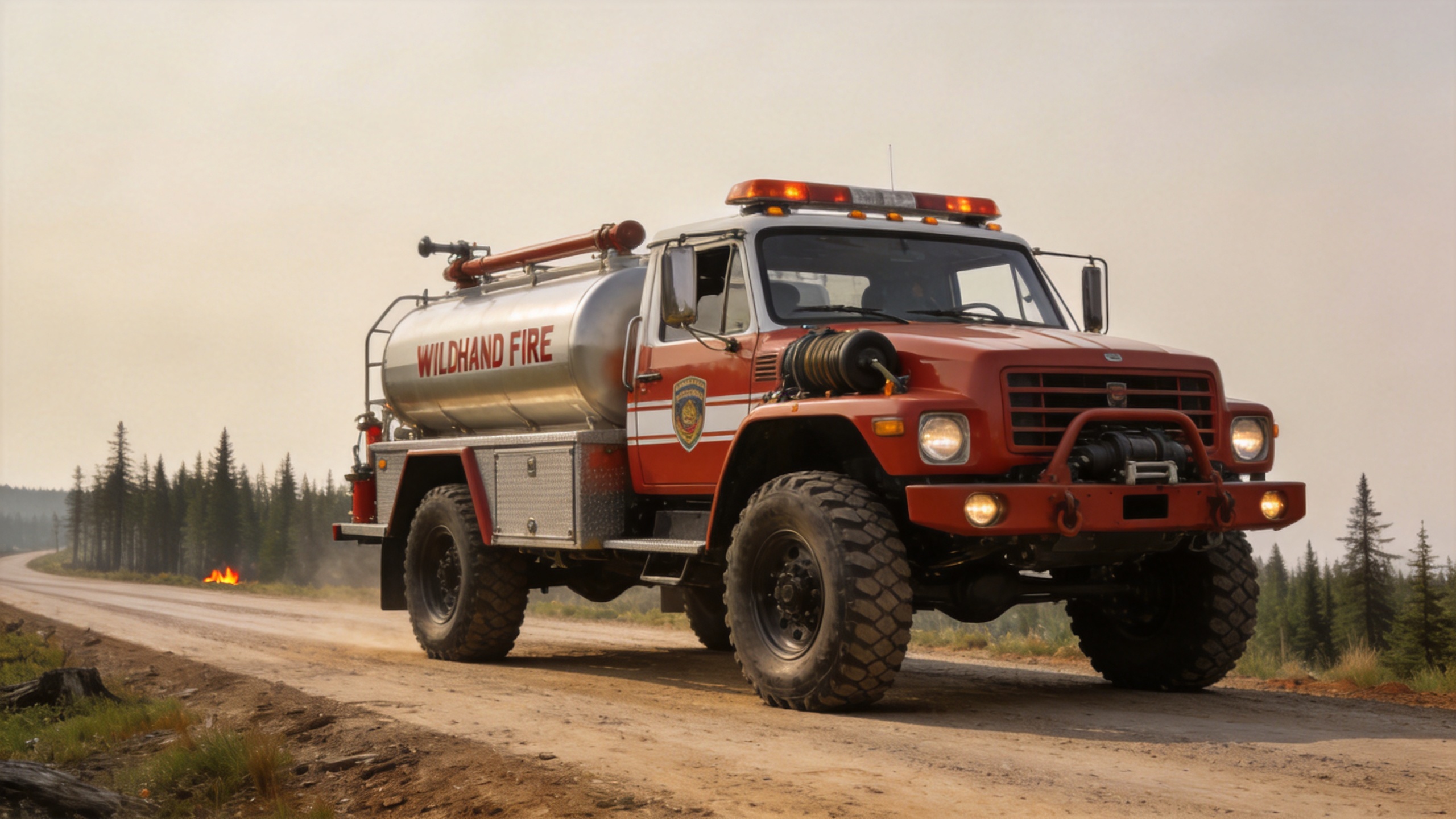
In practice, forest fire fighting trucks should be evaluated as a system. A large tank is valuable only if the chassis can reach a refill point and the pump, hose layout, and crew workflow can turn stored water into effective suppression. For a remote district, two agile units with compatible fittings may create more operational resilience than one very large truck.
Choose the chassis around terrain, payload, and recovery
Off-road capability begins with more than four-wheel drive. For forest fire fighting trucks, compare approach and departure angles, ground clearance, tire options, wheelbase, differential-lock strategy, braking, and recovery points. A long wheelbase can support a larger body and tank, but it can also reduce breakover clearance on rutted roads and slopes.
Payload deserves the same attention. Water is heavy, and a configuration must account for the tank, pump module, hose, tools, crew, fuel, and future accessories without exceeding the chassis limits. This is where buyers should ask for a loaded-weight calculation rather than relying on empty-vehicle dimensions. If site access includes weak bridges, narrow tracks, or steep descents, the operating weight matters as much as the nominal tank size.
Terrain also changes safety priorities. A protected cab, properly positioned seats and restraints, clear emergency egress, and a low, stable center of gravity can be more important than decorative add-ons. Rollover-risk controls should be reviewed against the actual slopes and surfaces expected in service.
Match tank, pump, and hose layout to the attack method
Many buyers focus first on tank capacity. That is understandable, but forest fire fighting trucks need a balanced water-delivery package. A larger tank can extend independent operation, while a smaller tank may improve access and mobility. The choice depends on whether water points are close, whether tenders can shuttle reliably, and whether the unit is expected to protect structures, conduct mobile attack, or support hand crews.
Pump-and-roll capability is especially relevant when a vehicle must apply water while moving along a fire edge. One cited NFPA 1906 discussion describes the concept as delivering 20 GPM at 80 psi while traveling at 2 mph; that is an illustration of the operating principle, not a substitute for a project-specific pump requirement. Confirm the required flow, pressure, controls, and local safety rules with the authority having jurisdiction.
Ask suppliers to explain suction arrangements, hose-reel position, booster line access, priming, drain points, and the compatibility of couplings with existing equipment. Forest fire fighting trucks become harder to use when crews must improvise adapters or cross the vehicle repeatedly to reach essential controls.
Specify crew protection and operational usability
Fireline conditions create heat, dust, vibration, reduced visibility, and fatigue. Therefore, forest fire fighting trucks need practical cab ventilation, lighting, communications mounting, secure tool storage, and controls that a trained operator can use with gloves. More automation is not automatically better. If the operating organization has limited maintenance resources, robust and understandable controls may provide greater real-world availability.
Training belongs in the specification. The handover plan should cover vehicle operation, pump procedures, water transfer, daily inspection, recovery planning, and basic fault isolation. A configuration is only as useful as the crew’s ability to deploy it under pressure.
Build a procurement checklist before requesting quotations
- Define the primary mission: initial attack, water shuttle, crew support, or mixed response.
- Map the worst access route, including grade, surface, turning space, bridge limits, and water points.
- Set loaded-weight and payload limits before selecting tank size.
- Specify pump duty, pump-and-roll need, hose lengths, couplings, and refill interfaces.
- Review cab safety, seating, restraints, visibility, lighting, and equipment retention.
- Ask for service documentation, spare-parts planning, and support arrangements in the destination market.
- Require inspection and acceptance testing that reflects the planned operating conditions.
For buyers that also need a general emergency-response platform, a 4x2 Emergency Fire Rescue Truck with Water Sprinkler Fire Fighting Truck Product can be reviewed as a separate road-oriented response option. Its suitability for a forest deployment still depends on verified chassis, terrain, payload, and suppression requirements.
Make the final choice on total readiness
The most effective forest fire fighting trucks are not necessarily the biggest or most feature-heavy. They are the units that reach the incident, place water where it is needed, protect the crew, integrate with the water-supply plan, and remain maintainable in the target market. Use the comparison matrix and checklist to turn operational needs into a clear specification. Then validate the final proposal with local fire authorities, route assessments, and an acceptance test under representative conditions.