EN

How to Select a 12 Ton Truck Mounted Crane
A 12-ton truck mounted crane can be a productive middle-ground for contractors, utilities, logistics operators, and equipment distributors that need substantial lifting capacity without moving to a separate mobile-crane fleet. Do not begin the assessment with the largest number on a brochure. Start with the lift you must make, where it must be made, and what the truck must still carry after installation.
That distinction matters especially for overseas buyers. A configuration that is practical on a paved urban jobsite may not be suitable for a rough access road, a restricted axle-load route, or a site with limited room for outriggers. The following selection process keeps the discussion focused on the complete working system: load, radius, boom, chassis, stability, and serviceability.
Begin With the Real Lift, Not the 12-Ton Label
“12 ton” is usually a nominal maximum lifting class, not a promise that the crane can lift 12 tons at every reach. For truck mounted telescopic cranes, usable capacity changes with the horizontal distance from the crane center to the load, boom extension, boom angle, outrigger position, and the operating configuration stated in the manufacturer’s load chart.
Before asking for quotations, make a short lift profile for the heaviest routine job:
- What is the heaviest item, including rigging, hook block, lifting beams, and any attachment?
- What working radius is required from the parked truck to the load pickup and set-down point?
- How high must the hook travel, and are there obstacles that force a longer reach?
- Will the crane normally work over the side, rear, or front of the truck?
- Will the work be repetitive, or is the heaviest lift an occasional exception?
Then compare those conditions against the correct load chart. When reviewing truck mounted telescopic cranes, keep a copy of the relevant chart with the inquiry so each proposed configuration can be checked against the same lift profile. If your priority is reliable lifting at a long working radius, the decisive factor is the charted capacity at that radius, not the headline class. A little capacity margin is often more useful than selecting a unit that only meets the requirement under its most favorable setup.
Match the Boom Type to the Work Pattern
When comparing truck mounted telescopic cranes, set the boom decision against your repeated lift pattern, not an isolated maximum-reach scenario.
Truck mounted telescopic cranes use straight telescoping sections to provide reach with a relatively direct operating logic. They can suit tasks such as placing materials, handling machinery, serving utility work, or moving loads where access is limited but a clear lifting path is available. The appropriate boom layout depends on the lift profile, not on whether one configuration looks more impressive in a product photo.
A longer telescopic boom may reduce the need to reposition the truck, but it also makes the actual-radius calculation more important. If the route includes narrow yards or dense job sites, check the stowed length, tail swing, working envelope, and clearance around the outriggers. If the task involves frequent load placement close to the truck, response speed and simple controls may deserve more attention than maximum reach.
Ask the supplier to show the rated-load information for the proposed boom, not a generic series chart. Also confirm which capacity applies with outriggers fully extended, partially extended, or in any other approved operating mode. Those conditions should match how the truck will actually be deployed.
Choose the Chassis and Crane as One Vehicle
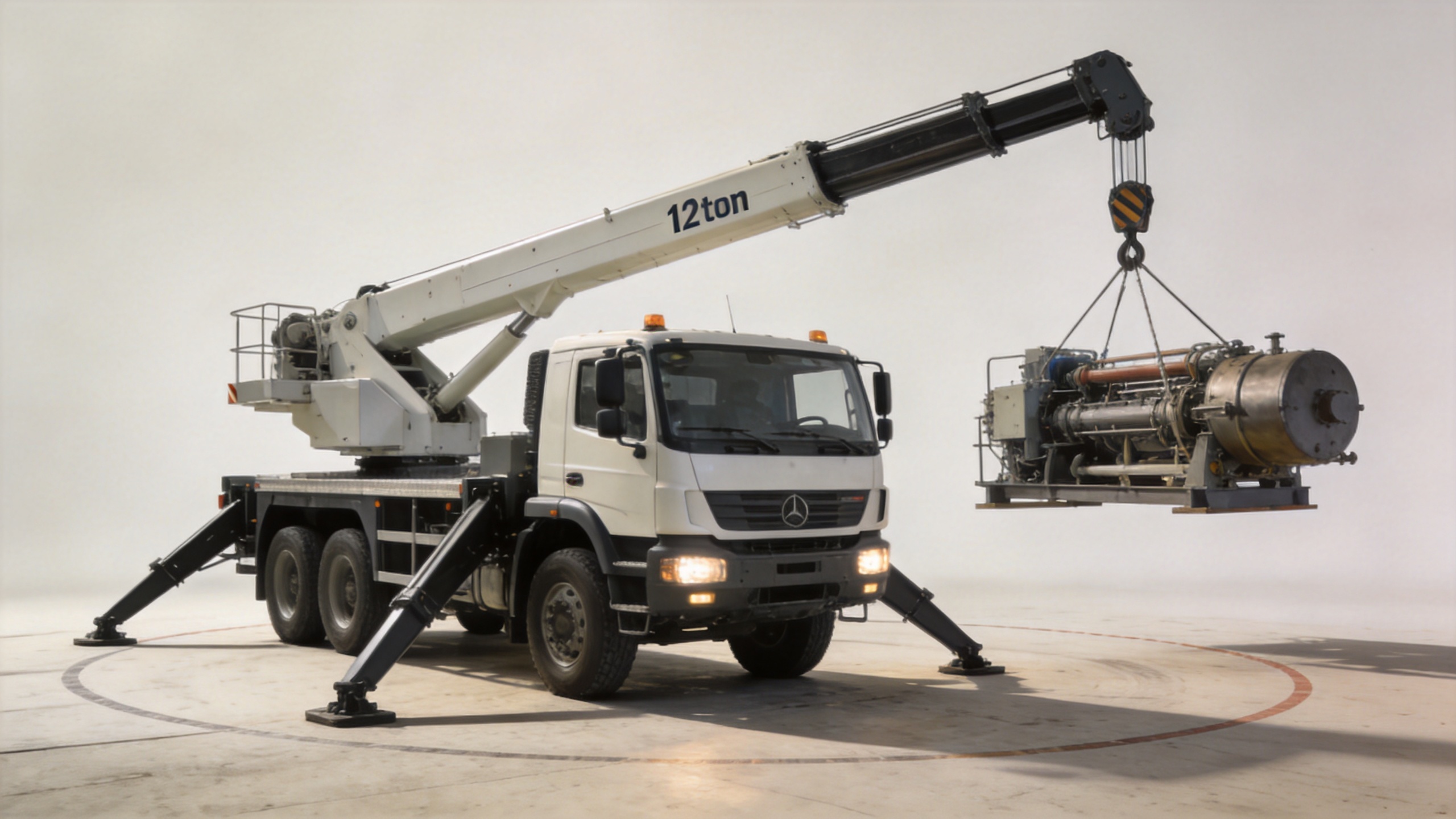
For truck mounted telescopic cranes, chassis selection is a lifting-performance decision as well as a transport decision.
A crane body and a truck chassis should be evaluated as a single engineered package. This is one of the most important comparisons when selecting truck mounted telescopic cranes for an export fleet. The crane, subframe, outriggers, hydraulic equipment, cargo body, fuel, tools, operator, and remaining payload all affect axle distribution and road usability. A chassis that appears adequate before installation can become a poor fit after the final body layout is added.
For this reason, give the supplier practical information early: target payload after crane installation, typical cargo dimensions, road regulations in the destination market, terrain, turning constraints, and whether the truck will travel long distances between sites. A 12-ton crane may be appropriate for a heavy-duty job, yet the purchase still needs to preserve legal axle loads and enough payload for the work you intend to perform.
For a current example of the category, buyers can review the Dongfeng 12 Ton Hydraulic Telescopic Boom Mounted Crane Special Transportation Truck Crane as a starting point for a truck-and-crane discussion. Confirm the final chassis, boom, body, and market-specific configuration with the supplier rather than assuming that a product-page title defines every delivered specification.
Do Not Treat Outriggers and Ground Conditions as an Afterthought
Safe operation of truck mounted telescopic cranes begins with the intended setup area, not after the truck arrives on site.
Truck mounted telescopic cranes depend on a stable setup. This requirement applies whether the work is routine material handling or an occasional high-consequence lift. Outriggers transfer forces to the ground, so the supporting surface matters as much as the crane’s mechanical rating. A level-looking surface can still have poor bearing capacity, buried voids, soft edges, recently backfilled soil, or underground services that make an otherwise routine lift unsafe.
Build a site-readiness check into your buying decision. Determine the expected outrigger spread, whether the work commonly occurs beside excavations or shoulders, and whether suitable pads or mats can be carried and deployed. The operating team should follow the manufacturer’s instructions and the applicable local lifting rules; a selection guide cannot replace a site-specific lift plan or a competent person’s assessment.
This is also where configuration trade-offs become visible. Compact outrigger arrangements help with confined access, while a wider approved setup can improve stability in the conditions described by the load chart. The right choice depends on the sites you serve most often.
Compare Hydraulic Controls, Service Access, and Lifecycle Support
Use this part of the evaluation to distinguish truck mounted telescopic cranes that look similar on paper but differ in daily operating support.
Technical capacity is only one part of value. Buyers of truck mounted telescopic cranes should compare the support model with the same care used for lifting performance. A crane that is difficult to inspect, diagnose, or support can create avoidable downtime. During supplier evaluation, ask how routine inspections are performed, what information the operator receives, how hydraulic components are identified, and how replacement parts and technical documentation are supplied to your market.
For international procurement, also verify practical compatibility: local fuel and road requirements for the chassis, available workshop capability, operator training expectations, shipping dimensions, and the documentation needed for import or registration. It is reasonable to compare purchase price, but total ownership cost also includes planned maintenance, parts availability, travel to service points, and the consequences of an unplanned outage.
A practical question is: “Which component would most likely stop this unit from working, and what is the support path if it fails?” A clear, evidence-based answer is more valuable than a broad promise of low maintenance.
A Practical 12-Ton Crane Selection Checklist
This checklist helps procurement teams compare truck mounted telescopic cranes on the conditions that affect routine work.
- Define the actual lift: record the maximum gross load, working radius, lift height, travel path, and frequency.
- Read the right load chart: compare the required lift with the correct boom, radius, and outrigger configuration.
- Confirm the working envelope: examine boom reach, clearance, truck position, site access, and the direction of lift.
- Verify chassis integration: check axle loads, subframe design, payload after installation, and destination-road requirements.
- Plan stable setup: consider outrigger footprint, ground bearing conditions, pads or mats, and typical jobsite constraints.
- Evaluate operating support: compare controls, maintenance access, manuals, parts, training, and service communication.
- Request a configuration review: provide your lift profile and use cases so the supplier can confirm the proposed vehicle configuration in writing.
Make the Final Decision Around Your Most Demanding Routine Job
The final comparison of truck mounted telescopic cranes should use the same documented lift profile for every candidate configuration.
The right 12-ton solution is the one that performs safely and efficiently on the lifts you do repeatedly, while remaining practical to drive, maintain, and support in your market. Do not choose solely by maximum tonnage, boom length, or initial price. Instead, use the load chart, the actual working radius, chassis integration, and setup conditions to narrow the field.
For buyers comparing truck mounted telescopic cranes, a well-documented lift profile is a strong starting point for a useful supplier conversation. It turns a broad request for a “12-ton crane truck” into a configuration decision that can be checked against real operating conditions.