EN
EN


Heavy Duty Tow Truck Buyer's Guide: Capacity, Safety Features and Key Configurations
When your fleet operates at ports, mine sites or highway recovery corridors, selecting the wrong heavy duty tow truck does not just slow response times. It creates operational liability. Yet most spec sheets read almost identically: Class 8 chassis, hydraulic boom, winch rating. The real differences surface only when you map each configuration against your actual recovery workloads.
This guide walks through the configuration checkpoints that procurement teams consistently underweight. It covers rated towing capacity, outrigger design, hydraulic arm reach, winch pull force and safety interlock systems — the factors that separate a heavy duty tow truck that performs reliably in the field from one that meets the spec sheet and little else.
What Qualifies as a Heavy Duty Tow Truck?
Classification matters before you begin comparing specifications. A heavy duty tow truck is defined by a Gross Vehicle Weight Rating (GVWR) exceeding 26,000 lbs — typically reaching 60,000 to 80,000 lbs when fully configured for recovery work. These vehicles are built on Class 7 or Class 8 chassis with reinforced frames rated for the dynamic stresses of sustained heavy recovery operations.
Standard heavy duty wreckers operate with boom capacities in the 25–50 short-ton range (23–45 metric tons). Rotator-class recovery vehicles — designed for complex overturns and multi-axle loads — extend that range to 35–75 tons. Understanding where your typical recovery incidents fall on that scale is the first filter in any serious procurement evaluation.
Rated Towing Capacity: Matching Tonnage to Your Recovery Scenarios
Rated capacity on a manufacturer data sheet reflects maximum static load under ideal conditions. Field recovery — particularly in port container yards or mine haul roads — rarely presents ideal conditions. A useful starting point is mapping tonnage requirements by application:
- Highway recovery (semi-tractors, flatbed trailers, coaches): 20–35 ton boom capacity covers most incidents; rotator capability recommended for overturned rigs.
- Port equipment recovery (reach stackers, terminal tractors, heavy forklifts): Minimum 40-ton boom; dual winch configuration strongly preferred for asymmetric loads.
- Mining site recovery (haul trucks, excavators, mobile crushers): 60-ton and above; integrated underlift with rotator capability required for disabled loads on uneven terrain.
If most of your operations involve loads below 30 tons, an integrated heavy duty tow configuration — combining wheel-lift, boom and carrier functions at up to 50,000 lbs — typically offers the better cost-to-versatility ratio. For fleets where overturned vehicles and off-road extractions occur regularly, the 35–75 ton rotator class becomes the more cost-effective long-term choice despite the higher initial purchase price.
Outrigger and Hydraulic Arm Configuration
Outrigger design is one of the most under-scrutinized specifications in heavy duty tow truck procurement. The outrigger system determines the stability envelope during all crane operations — inadequate spread width or insufficient ground bearing capacity directly limits where and at what load the vehicle can operate safely.
Configuration dimensions to verify before any heavy duty tow truck purchase:
- Outrigger spread width: Confirm the operating spread fits your typical deployment environment — port lane widths, mine road shoulders and highway shoulder clearances all impose practical limits.
- Hydraulic arm reach: Minimum 4-meter effective reach for standard highway recovery; 6 meters or greater for median-recovery or deep-ditch operations.
- Ground bearing pressure: Outrigger pads must be rated for the soil conditions at your primary deployment zones — paved highway versus unpacked mine surface requires different pad dimensions.
A common procurement error is selecting boom capacity without confirming that the outrigger system supports that capacity at full operational extension angles. A heavy duty tow truck rated at 40 tons with outriggers certified to only 30 tons at 90-degree extension is a constrained asset, not a full-capability one.
Winch Pull Force: Selecting the Right Recovery Power
Hydraulic winches on heavy duty recovery vehicles range from 8,000 lbs on light-integration platforms to 50,000 lbs on dedicated recovery units. The 60-ton class typically specifies planetary winches with a 50,000 lb rated working load limit, mounted on 3/4-inch wire rope.
For B2B procurement teams, the specification question goes beyond maximum pull force. Three dimensions matter:
- Dual independent winch configuration: Essential for extractions requiring simultaneous pulling vectors — common in multi-vehicle highway incidents.
- Hydraulic spooling speed: Relevant when time-on-scene is a billable metric; faster retrieval directly affects per-incident margin for recovery operators.
- Wire rope specification: Diameter, length and breaking strength must all be verified against the winch drum's rated capacity and the vehicle's operational reach requirements.
Safety Interlock Systems: Non-Negotiable Configuration Standards
Safety interlocks are the configuration element most frequently described in generic terms during the sales process and least often validated through documentation before purchase. For heavy duty tow operations — where a load shift can endanger recovery crew and other road users simultaneously — these systems require explicit specification and certification review.
Minimum interlock requirements for heavy duty road recovery operations:
- Boom overload protection: Automatic cut-off at rated capacity with audible and visual pre-limit warning.
- Outrigger deployment confirmation: Prevents crane operation until all outriggers are confirmed pressure-stable and at operating spread.
- Hydraulic pressure relief: Protects the hydraulic circuit during sustained winch or boom loads at near-rated capacity.
- Anti-two-block device: Prevents hook-block contact with the boom tip during crane lift operations — required under most commercial recovery certification standards.
Request certification documentation for each interlock system matched to your target deployment country's standards — IEC, SAE or applicable local commercial vehicle regulations. A checkbox on a sales sheet is not a substitute for traceable certification.
Flatbed Towing Truck vs. Wrecker: Choosing the Right Recovery Configuration
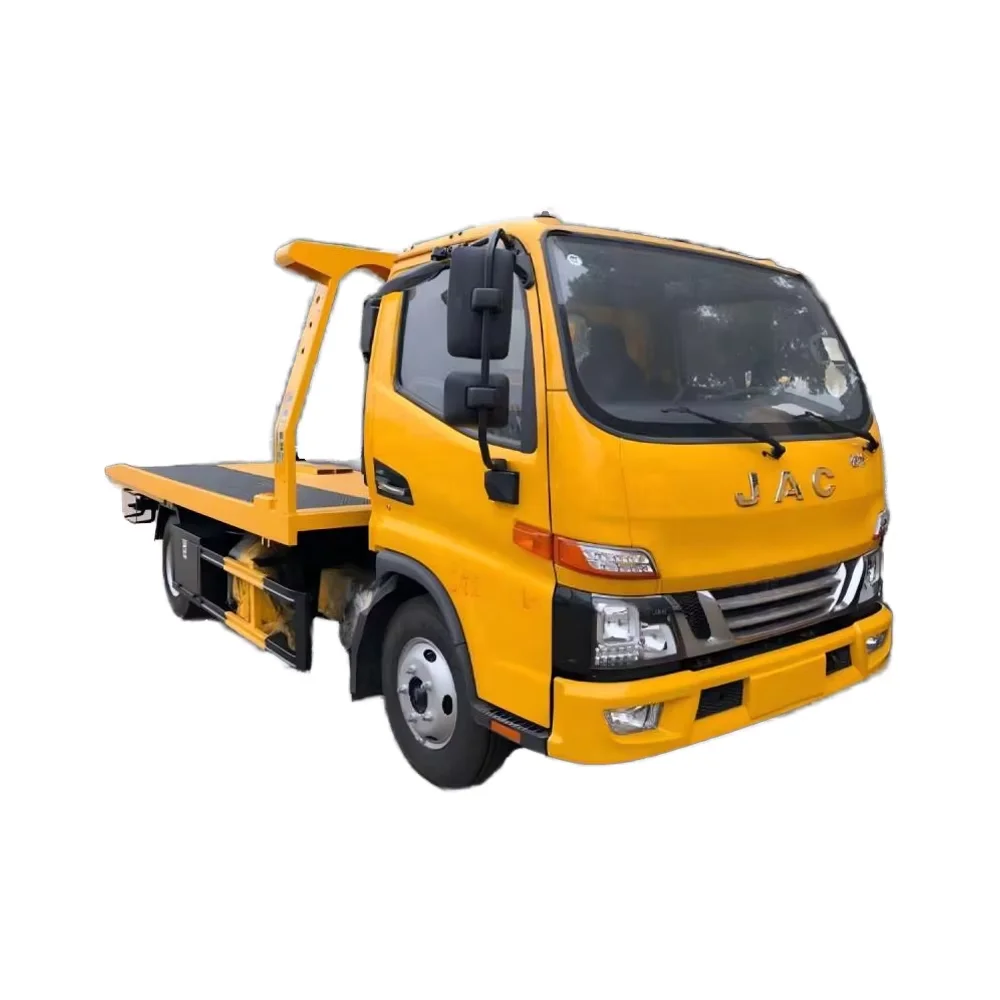
The flatbed towing truck configuration is increasingly specified for highway and municipal recovery programs where vehicle preservation carries contractual weight. Unlike a traditional wrecker that lifts from the axle, a flatbed carrier loads the full vehicle — reducing secondary damage risk for commercial vehicles, police fleet assets and cargo-carrying trucks where the load must arrive intact.
A flatbed towing truck configuration is the stronger choice when:
- The disabled vehicle is an all-wheel drive or four-wheel-steer unit that cannot safely be lifted at a single axle
- Axle or suspension integrity on the recovered vehicle is uncertain following the incident
- Recovery contracts include vehicle-condition liability clauses
A traditional heavy duty wrecker configuration is preferable when:
- Rapid roadside clearance is the primary objective — articulated vehicles, overturns and jackknifed trailers
- Operating in confined spaces where a full-length flatbed towing truck cannot maneuver
- Multi-vehicle incidents require combined lift-and-carry in a single deployment
For fleets that need both functions, CLW Trucks offers flatbed wrecker configurations on both JAC and Dongfeng 4x2 chassis, supporting 3 to 5-ton payloads with an integrated crane arm — a practical dual-function option for highway maintenance operators and municipal recovery contracts. The 2025 JAC chassis flatbed tow truck with crane and the Dongfeng 4x2 flatbed wrecker for recovery and repair support multi-market chassis specifications, reducing lead times and import compliance complexity for international procurement teams.
Procurement Validation Checklist
Before finalizing a heavy duty tow truck specification, procurement teams should work through this sequence:
- Scenario map documented: Primary recovery vehicle types, typical weights, terrain and access conditions recorded for each deployment zone.
- Boom and outrigger ratings verified at operational extension angles, not solely at maximum static capacity.
- Winch pull force: Confirm the winch can sustain rated pull across multiple consecutive cycles under the fleet's typical recovery workload, not just peak single-pull capacity.
- Safety interlock documentation: Review certification evidence for each interlock system and cross-reference against the target deployment country's commercial vehicle standards.
- Chassis specification reviewed for destination axle weight limits, road width restrictions and emissions compliance as applicable.
- Spare parts and maintenance support confirmed in the target market — particularly for hydraulic components, control systems and winch assemblies.
Use these specifications as a starting baseline. A heavy duty tow truck configured for your operational conditions — not the industry average — is the procurement outcome that delivers long-term value for recovery fleets, port operators and mining maintenance teams alike.